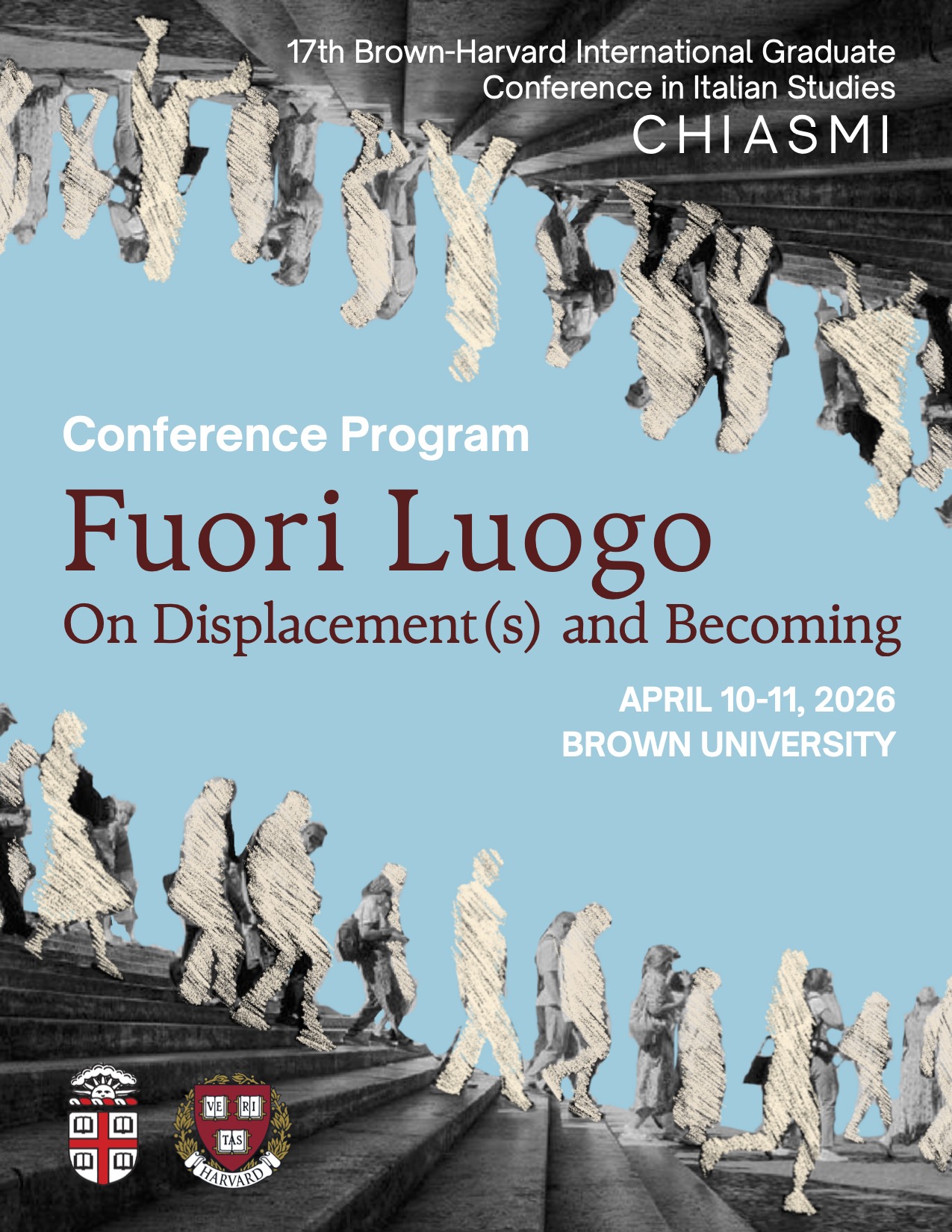
Robida will be participating to the 17th Brown-Harvard International Graduate Conference in Italian Studies CHIASMI with the title Fuori Luogo: On Displacement(s) and Becoming.
They will take part to the Panel titled Practices of Rethinking Spaces and Beloging with a paper with the title Dwelling as Committing: On situated practices in post-displacement rural territories. The Case of Robida Collective..
More about the conference here
The event is organised Agata Nipitella, Andrea Zoller, Irene Fiducia, Sara Buitrago Montero.
Dwelling as Committing
On situated practices in post-displacement rural territories. The case of Robida Collective
The paper will present the editorial and spatial practice of Robida, a collective of researchers, architects, designers and artists, based in the small mountain village of Topolò/Topolove (Udine, Italy), on the border between Italy and Slovenia, which publishes, organises, hosts, curates and facilitates learning events, publications, symposia, workshops, radio broadcasts, and community spaces.
The presentation will outline Robida’s presence in the village as a reaction and resistance to the physical, cultural and epistemic displacement which was imposed on the communities inhabiting the Italian-Yugoslav borderland during the second half of the 20th Century. A commitment to dwell in the village and to develop situated cultural production (from) there is how this resistant practice manifests itself.
As an alternative to living in capitalist ruins, Robida is finding ways of inhabiting and staying with capitalist leftovers, places that have morphological, architectural, and cultural qualities that were spared by processes of modernization. In the case of abandoned rural villages, staying means attempting to find modes of inserting oneself in a place’s already-established networks. Robida formed a collective and “actively became in context,” a process that the artist Jeanne van Heeswijk defines as a “balancing act between making emergent and re-rooting.” Key to this has been discovering historical, social, and physical facts about the place, which provided entry points for reconfiguring its metaphysical connective tissue.
By engaging with contemporary and earlier Italian authors and scholars, among which Cristina Campo, Anna Maria Ortese and Daniela Cascella, and contemporary theory and by presenting Robida’s cultural practice, the paper will explore how returning to and inhabiting a specific place can stimulate embodied forms of curating and publishing intended as placemaking practices.