Diary on Building-with: towards architecture on the margin
This diary is about building, both as a noun and as a verb.
We like to think of Topolò/Topolove as a place of possibilities. One of these is the transformation of leftover imaginaries and landscapes.
By focusing on the renewal of a particular space in the village, we would like to archive thoughts that are inherent to processes of change. This is where the need for this diary came from.
curated and narrated by Elena and Antônio
June 2026
Antônio
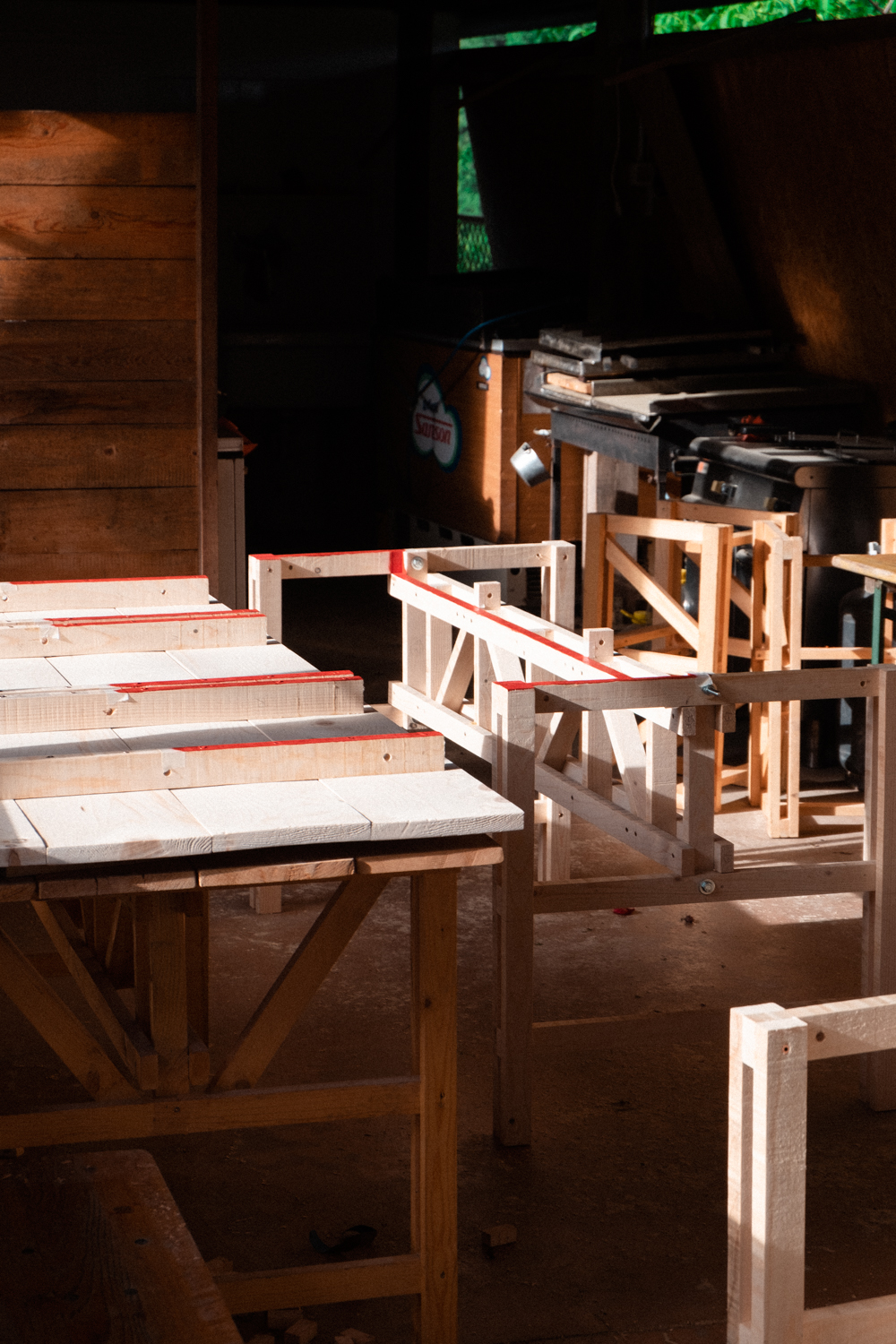
Spring commitments made the worksite at Stalla come to a halt. Nevertheless, the woodworking tools we acquired last year to build Log were put to good use. From June 10 to July 2nd, Robida presents Between Roots and Crowns at Museum of Contemporary Art Metelkova, +MSUM, and for this occasion we needed two new tables. We turned to a 1974 design by Enzo Mari, adapted by the selfbuilding practice of POP adriatico in 2024, executed in Fir wood.
For a week, Chiosco was turned into a furniture workshop. While handling the tools we shared with Madalena and Diogo between dry-stone wall terraces below the village last year, I was constantly reminded of the difference between work guided by the detached blueprint and work informed by a situated mode of execution. Cutting milled lumber to standardized lengths, as the current task required, stood in stark contrast to the process of building Log, which involved sourcing and transforming materials ourselves and ultimately drew us into close dialogue with the particular character of wood.
Yet this is not to imply that anticipation in or abstraction of design are inherently at odds with attention towards the specificity of making. While conceiving of an open source blueprint in the mid 1970s, the underlying ambition of Mari's Autoprogettazione was precisely to sever the barrier between consumer and laboring force, granting autonomy to the user by DIY making. To do so, he designed a process for assembling furniture which would be available to anyone who could lay their hands on a simple set of tools (at the barest minimum, a saw, a hammer and some nails).
I have recently written about how, as revolutionary as it was, Mari’s proposal sits uneasily under neoliberalism. As labour is outsourced from the factory to the home, it may inadvertently precarize both working and living conditions. Although the blueprints remain an open source design, in a context where craft knowledge has been progressively eroded and skilled labor made structurally inaccessible, the invitation to build for oneself reads less as an act of emancipation than as a transfer of costs and liability of production onto the individual. While I do stand by this reasoning, here I want to sit with the other facet of that problem and explore what building these tables in early summer 2026 actually made me think, and how the act of making them complicated my own, detached critique.
The iconic image of Mari's standardized furniture comes from its bare union between process and result. These objects have great appeal to architects, artists and designers while generating mild resistance from part of the general public because of their characteristic lack of comfort. While this certainly raises the question of how much comfort do we actually need—and brings to mind other paradigmatic chairs, such as those by Álvaro Siza or Lina Bo Bardi, who allegedly designed uncomfortable seats in order to keep the sitter's attention awakened—I would like to set that aside for now and focus on the processual dimension of these objects and turn, once again, to Sérgio Ferro.
When one looks at an Enzo Mari table, its logic of construction is immediately comprehensible because the joinery is fully exposed. Every point where elements meet is accessible to the eye and, by extension, to the hand. There is something disarmingly honest in this choice. The pragmatic approach Mari employs is capable of elevating the surprisingly unskilled execution of this object to the level of considered furniture design. The fact that this aesthetic quality is really a side effect of the designer's ethics makes the achievement all the more compelling. By reducing all structural members to a single cross-section, Mari ensures that the same batten, cut at different lengths, is sufficient to build the whole.
In the context of production, the design intelligence Mari cunningly mobilizes can be further understood with the aid of Ferro's conceptual repertoire. Across several texts collected in Arquitetura e Trabalho Livre, the Brazilian architect distinguishes between what he terms Drawing for Production and Drawing of Production:
Drawing for Production is the conventional architectural drawing, communicated through blueprints and specifications. It is produced before and apart from building, commanding the site from a distance and translating the architect's intention into instructions for workers to execute. In this mode, knowledge and decision-making are concentrated in the designer and the worker is reduced to the condition of instrument of someone else's thought. The drawing precedes and governs production;
Drawing of Production is something closer to a record or trace of the act of making itself. It is a kind of design that emerges from engagement with materials, tools and conditions of labour. Because it is conceived in dialogue with contextual constraints, it remains embedded in the productive process rather than standing above it. Importantly, this approach still involves some form of prefiguration—after all, it is a drawing conceived beforehand—but it may remain strategically vague in regard to certain specifications, staying open to interpretation and adaptation in situ.
The political charge of the distinction is that Drawing for Production enacts a fundamental separation between intellectual and manual labor by severing conception from execution, a tendency that Drawing of Production tries to counter. Writing in the same years that Mari's designs were being made and circulated, Ferro saw the separation which Mari was attempting to address in his own way as both epistemically violent and structurally tied to capitalist relations on the building site.
Over fifty years after its design, Mari’s furniture remains genuinely uncomfortable. Not because of the hardness of its flat surfaces, but because of the firmness of the questions it continues to ask. While its status has shifted within Mari’s own lifetime, with what was initially a provocation eventually being able to circulate frictionlessly within the very design culture it set out to challenge, the underlying question has not been answered: what does it mean to make something yourself, and what does that making do to you? To assemble a Mari table is to be briefly implicated in the relationship between thinking and making, designing and executing, autonomy and dependence. It is, perhaps, as good a place as any to inquiry about the meaning of building-with.
February 2026
Antônio
The beginning of 2025 has been set by the alternating rhythm between engaging the head and the hand. When it was sunny outside, we would work at the barn. When it was raining, we stayed inside and I would read from Sérgio Ferro’s collected writings. I have been amusing myself by noticing parallels between two distant and disparate contexts: on the one hand, the disenchantment with architectural modernism and the search for new directions in the aftermath of the heroic experience of building Brasília in the 1960s and 1970s, as experienced by a young Ferro; and, on the other hand, the situated exercise of approaching the building site as an epistemological arena at the periphery of capitalism in the village of Topolò today. Perhaps I should try to defend this intuition—which at first sight seemed entertaining, though ultimately risible—but which has nonetheless been growing on me. It has to do with the autotheoretical path of an architect forced into exile in France in the aftermath of the military coup in Brazil in 1964.
Sérgio Ferro was trained as an architect in São Paulo and, still as a student, found himself involved in the construction of the new capital. As a young architect, he witnessed firsthand the contradiction between the utopian promises of Brazilian modernism and the brutal realities of its execution. In particular, he was struck by the contrast between the celebrated formal audacity of figures such as Niemeyer and Artigas—paradoxically affiliated with the Brazilian Communist Party—and the archaic building processes sustained by the exploitation of anonymous and underqualified labor. The experience of Brasília became a monumental turning point which, for Ferro, exposed how the contemporary disposition of the architectural profession was founded upon concealed social and epistemic violence.
In the late 1960s, together with Rodrigo Lefèvre and Flávio Império, Ferro became a central figure in what came to be known as Arquitetura Nova. The group articulated a critique of architecture from the building site outward, placing labor, technique and modes of production at the center of architectural discourse. Their work rejected the separation between design and construction, insisting that architecture could only be understood—and transformed—through direct engagement with the conditions under which it was built.
Somewhat unexpectedly, this position (and even its name) was derived from the world of moving pictures. The trio was influenced by the contemporaneous cultural movement of Cinema Novo, particularly the work of Glauber Rocha. Like Rocha’s films, Arquitetura Nova embraced scarcity, production constraints and incompleteness as critical tools. It proposed a way of doing that acknowledged Brazil’s condition as a peripheral country within the capitalist system and, rather than importing models from the industrialized center without critique (which would only reproduce structural dependency), it assumed a situated position from which to work from. After the military coup of 1964 and his involvement with the armed resistance, Ferro was forced into exile, where he continued to develop his ideas within the French academy—not because he could not sustain a practice coherent with this theoretical position, but because he lacked an architectural license in his new country.
How does all of that fit into our barn?
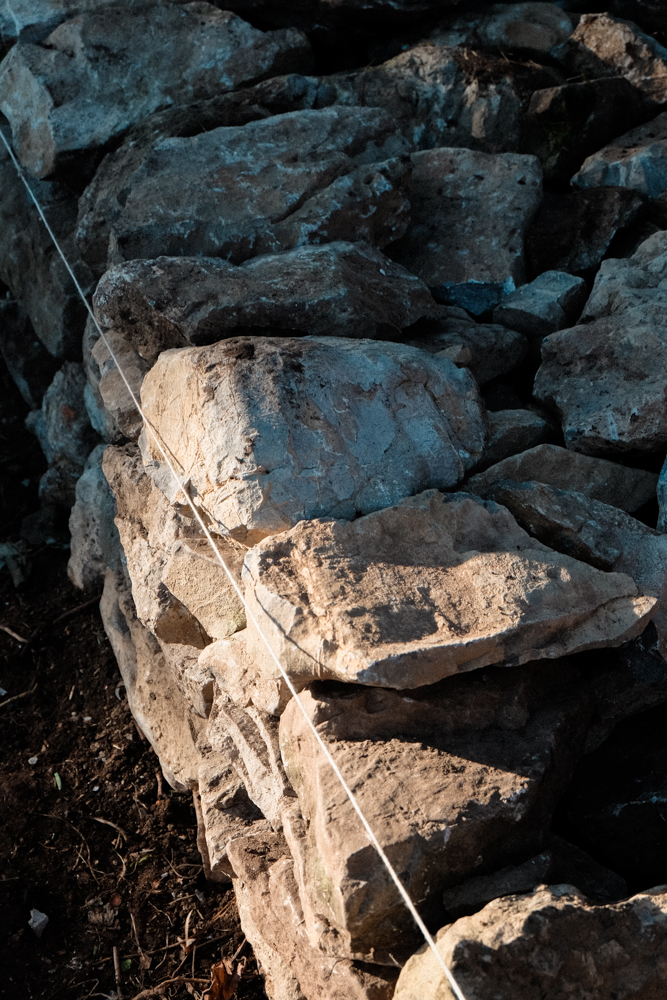
The immediate answer is that it does not fit into the barn at all. Perhaps for this very reason, the first architectural intervention we carried out was not on the building itself, but on the site surrounding it. In order to clear access and regain space in which to work and dream, we began by extending an existing dry-stone wall that had partially collapsed. As we cleared the overgrown plot adjacent to the barn, it became evident that the topsoil was saturated with construction debris left behind by former neighbors. Building a new retaining wall in front of this accumulation, and backfilling it with earth excavated from the barn itself, allowed us to reconstitute a stable terrace. With improved conditions, the terrain became accessible again and a new exterior space was carved out of abandonment.
The negotiation with the residues of the past was not merely a matter of concealing waste, but also a practice of material reuse. I cannot quite articulate the satisfaction of placing old stones while knowing that their position is provisional—even if, when done carefully, such an arrangement might endure for generations, like the terraces that surround us here. This awareness of the simultaneous rhythms of deep time and human time in this kind of labour seems intrinsic to working with the medium of stone.
Across Mediterranean valleys, stone is the quintessential material for transforming steep slopes into fertile ground. Retaining walls were built exclusively from it, in a process that simultaneously cleared boulders from the fields and rendered the land cultivable. The joinery involved varied from region to region: at times as rough as the irregular geometry of freshly quarried stone as excavated from the earth, at others worked with a hammer and chisel to varying degrees of regularity. In all cases, through slow and intuitive labor, a loose assemblage of rocks would come to act as a single bearing body. Beyond its remarkable effectiveness, the longevity of this tradition may lie in its accessibility: all the materials required for construction were already at the site and to build something new simply meant reorganizing preexisting elements.
Around the barn, the stones we handled came from collapsed walls and nearby ruins. Once laid into this new wall, their past lives remain faintly legible to the attentive eye. Some still carry worked faces that hint at their former role as architecture; others, smoothed by the hooves of animals, point to their use as pavement; while yet others, fractured and raw, are deployed just as they eroded from the mountain. These differences are absorbed into the wall’s logic and remain legible. The emergent structure is a stratified body, composed of multiple temporalities held together by the weight of the histories that shaped them.
To return, finally, to Ferro: even before any material intervention, our first step toward building our studio was the constitution of a poetics of economy, which could respond to the specificities of working at the margins. Within such a context, the most contemporary techniques are not necessarily the most adequate, and certain solutions that have become inaccessible elsewhere due to the labor they require may instead be reclaimed through one’s own time. Equally important was the adoption of a didactic way of building: solutions that openly expose how they were made and, in doing so, allow knowledge to be restituted to those who encounter them in the future.
February 2026
Elena
From an idea of Antonio during dinner, we started to write this diary. Thank you Antonio!
Come ogni inizio anno, si parte sempre con i buoni propositi. In entrambe le nostre liste quest’anno c’era il desiderio di dedicarsi di più, o con più costanza, a trasformare la stalla.
L’architettura mi ha sempre affascinato perché contiene in sé l'essere “in potenza”. Ciò che hai di fronte si trasformerà inevitabilmente: sia mettendoci mano, sia lasciando le cose come sono. Diventerà rovina, discarica, foresta o casa.
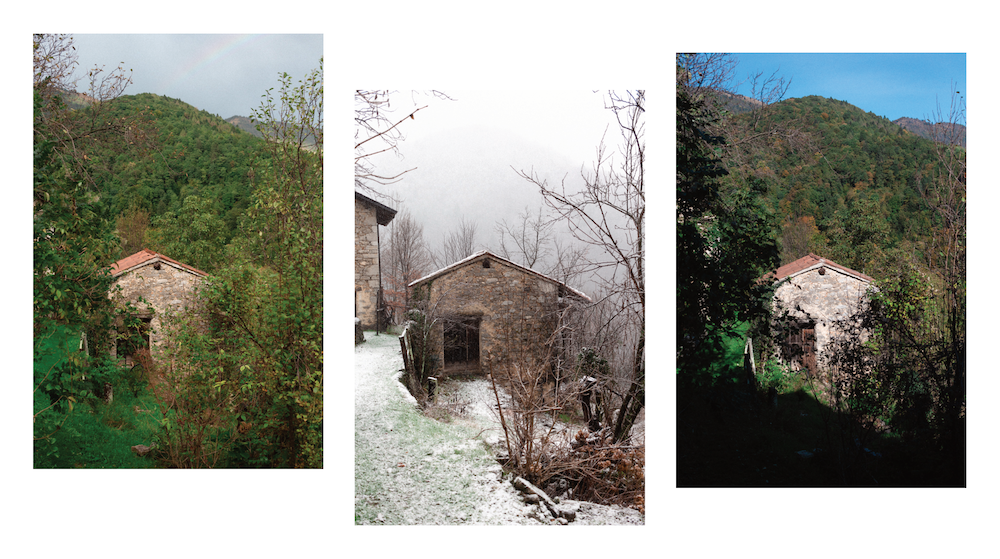
Ormai quasi 5 anni fa comprai la casa in cui vivo a Topoló e con essa anche la stalla in fondo al paese. Posto bellissimo perché lontano da tutto, posto scomodissimo perchè lontano da tutto.
Ho sempre voluto vederci qualcosa “in potenza”. Uno studio, un atelier, una piccola casa? E cosí ho iniziato a sognare ad occhi aperti.
Un bel gioco: 4mx4m di possibilità. Una misura abbastanza piccola per essere luogo di gioco, scelte, sperimentazioni e lavoro autonomo (per adesso).
Le idee non sono ancora del tutto chiare su come sarà, ma negli ultimi anni abbiamo iniziato con dei primi passi come lo svuotamento e con la pulizia del contesto. Quest’anno il primo obiettivo della lista era quello di spostare un cumulo di pietre (probabilmente lì da decenni) per poter poi mettere l’impalcatura attorno all’edificio. Le pietre, visto che non abbiamo tanto terreno a disposizione ed è tutto una pendenza, si stanno trasformando in un muretto a secco. Il primo muretto a secco di Antonio.
Le ore le passiamo a fare gesti ripetuti. Ogni gesto muove e trasforma qualcosa. Qualche volte sono gesti visibili altre volte invisibili. Agiamo con ripetitività e lentezza.
La lentezza del nostro lavoro è per me qualcosa di affascinante. Siamo cosí abituati all’immediato, alla performatività, all’efficacia. Per ora invece abbiamo solo le nostre braccia e il nostro tempo. Il tempo lento da dedicarci.
Antonio costruisce il muretto, mentre io pulisco i rovi o scavo il pavimento nella stalla e procuro terra per “riempire” il muretto. Procediamo così qualche ora al giorno, quando c’è il sole o per lo meno non piove.